Bunting for Small Spaces: Apartment-Friendly Party Decor Ideas
October 13, 2026 - Event Inspiration
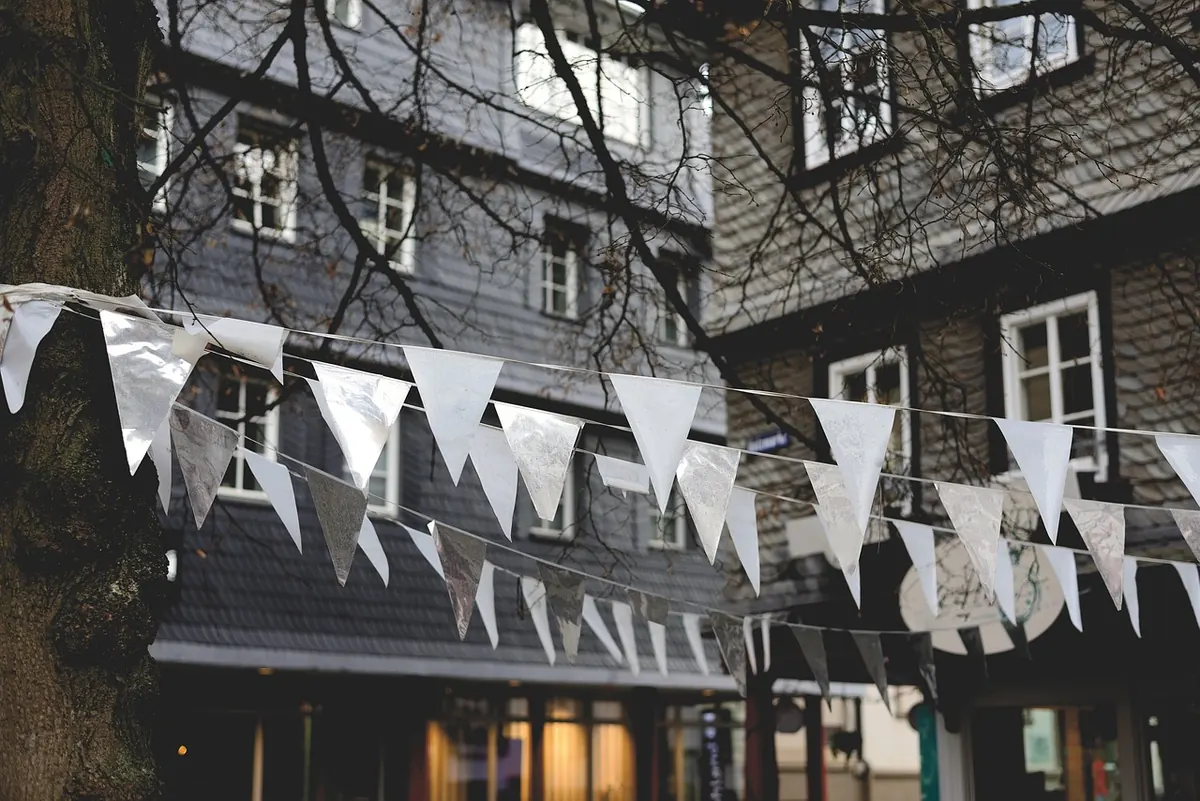
Bunting is one of the most forgiving decorations you can hang. It is light, it looks good from almost any angle, and a single string can turn a plain wall into a party. It also goes wrong in the same few ways every time: a sad droop in the middle, a knot you cannot undo, a corner that peels off the wall halfway through the afternoon. Almost all of it comes down to ten small oversights, and none of them are hard to fix once you know what you are looking at.
Unroll the bunting on the floor before anyone climbs a ladder. Count the flags, measure the run, and work out whether the two numbers agree.
Flags spaced roughly 15 to 18 centimetres apart, centre to centre, look full without crowding. A four-metre run therefore needs somewhere between 22 and 26 flags. If your string has 12, you either need a shorter run, a second string, or a deliberate, wider spacing that reads as airy rather than sparse. Decide which before you drill anything.
While you are at it, check what else is in the way: ceiling lights, smoke alarms, curtain rails, the swing of a door, a heat vent. Mark your intended anchor points with a scrap of painter's tape, step back, and look. Moving tape is free. Moving a hook is not.
Two opposite errors, same result. Some people pull the line so tight the anchors come out of the wall. Others leave so much slack that the bunting hangs like a wet hammock.
Tension only cures a dip on a short run with solid anchors. Beyond about three metres, gravity wins, and tightening the line simply transfers the load to your hooks. Add support in the middle instead: a cup hook in a joist, an adhesive hook on the ceiling, or a length of clear fishing line dropped from a beam and tied around the tape.
A pronounced dip can look deliberate, but only when it is symmetrical and repeated. Measure from your centre point out to each end, match the two halves, and treat every 1.5 metres as its own small curve rather than one long droop. Two identical swags read as design. One lopsided sag reads as a mistake.
For the knots themselves, a taut-line hitch slides to tighten and then holds under load, and a trucker's hitch gives you a two-to-one pull. Wrap the cord twice around the anchor before tying, so the knot is not the only thing carrying the weight.
Masking tape on a freshly painted wall, a pin in a textured ceiling, a string tied to a chair that somebody will move by lunchtime. Match the fixing to the surface and most of these vanish.
Whatever you choose, test it while you still have time to change your mind. Hang the bunting, give the line a firm but gentle tug, and wait half a minute.
Even spacing suits a straight run across a plain wall. Everywhere else — around a corner, over a doorway, along a stair rail — the flags need to gather slightly so the tape can bend without stretching.
Then there is the slow slide. Flags drift along the string during the day, bunching at the low end and leaving a gap at the top. A few small habits stop it:
Most knot disasters happen before the bunting leaves the box. Coil it around your elbow like a garden hose and you will spend the first twenty minutes of setup undoing your own work.
Wind it in a figure of eight instead: loop around your thumb, then around your little finger, alternating, so the string crosses itself in the middle. It comes off the same way it went on. A piece of cardboard with notches cut into each end works just as well, and a labelled bag stops next year's version of you from guessing which string is which.
On the day, walk the line out between two people, one at each end. If a knot does form, do not tug it tighter. Push the loops back toward the knot to loosen
Photo: congerdesign / Pixabay

Bunting does not need an entire wall. Here is how to scale pennants, garlands and streamers for apartments,...

Clean, untangle, and roll your bunting before storing it in a cool, dark, breathable container—so next season's...
Copyright © 2026 Bunting Beacon. All Right Reserved.